
























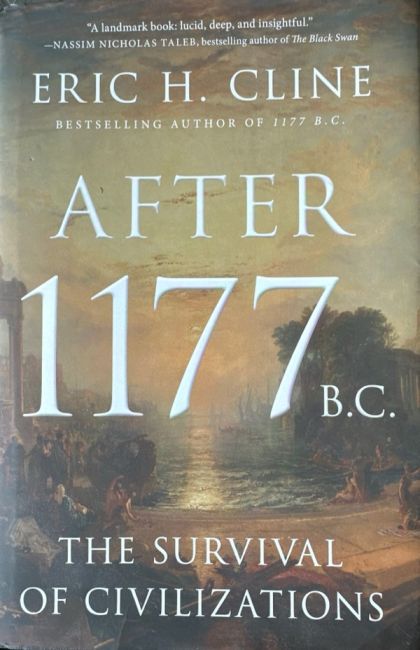
After 1177 B.C.: The Survival of Civilizations (Turning Points in Ancient History, 12)
the survival of civilizations
Cline, Eric H.
May 7, 2024 · Hardcover · Princeton University Press · 360 pp
First edition · ISBN 9780691192130 · English · Dewey 937/.01 · LC GN780.25 .C55 2024
Hardcover
In this gripping sequel to his bestselling 1177 B.C., Eric Cline tells the story of what happened after the Bronze Age collapsed—why some civilizations endured, why some gave way to new ones, and why some disappeared forever“A landmark book: lucid, deep, and insightful. . . . You cannot understand human civilization and self-organization without studying what happened on, before, and after 1177 B.C.”—Nassim Nicholas Taleb, bestselling author of The Black SwanAt the end of the acclaimed history 1177 B.C., many of the Late Bronze Age civilizations of the Aegean and Eastern Mediterranean lay in ruins, undone by invasion, revolt, natural disasters, famine, and the demise of international trade. An interconnected world that had boasted major empires and societies, relative peace, robust commerce, and monumental architecture was lost and the so-called First Dark Age had begun. Now, in After 1177 B.C., Eric Cline tells the compelling story of what happened next, over four centuries, across the Aegean and Eastern Mediterranean world. It is a story of resilience, transformation, and success, as well as failures, in an age of chaos and reconfiguration.After 1177 B.C. tells how the collapse of powerful Late Bronze Age civilizations created new circumstances to which people and societies had to adapt. Those that failed to adjust disappeared from the world stage, while others transformed themselves, resulting in a new world order that included Phoenicians, Philistines, Israelites, Neo-Hittites, Neo-Assyrians, and Neo-Babylonians. Taking the story up to the resurgence of Greece marked by the first Olympic Games in 776 B.C., the book also describes how world-changing innovations such as the use of iron and the alphabet emerged amid the chaos.Filled with lessons for today's world about why some societies survive massive shocks while others do not, After 1177 B.C. reveals why this period, far from being the First Dark Age, was a new age with new inventions and new opportunities.
More in Turning Points in Ancient History
 1177 B.C. (Revised and Updated)
2021 · Audiobook
1177 B.C. (Revised and Updated)
2021 · Audiobook
 1177 B.C.: 6 (Turning Points in Ancient History)
2021 · Ebook
1177 B.C.: 6 (Turning Points in Ancient History)
2021 · Ebook
More by Cline, Eric H.
1177 B.C. (Revised and Updated)
2021 · Audiobook
1177 B.C.: 6 (Turning Points in Ancient History)
2021 · Ebook
 After 1177 B.C.
2024 · Hardcover
After 1177 B.C.
2024 · Hardcover
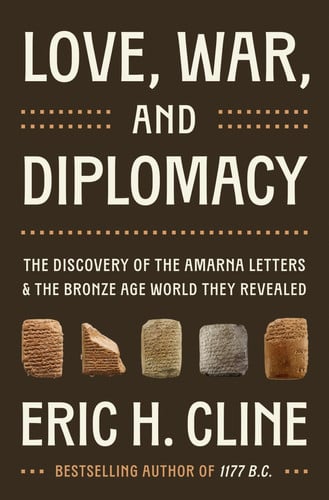 Love, War, and Diplomacy The Discovery of the Amarna Letters and the Bronze Age World They Revealed
2025 · Hardcover
Love, War, and Diplomacy The Discovery of the Amarna Letters and the Bronze Age World They Revealed
2025 · Hardcover
Partial where an author was entered under two spellings — 34 such pairs are being merged in CLZ.